
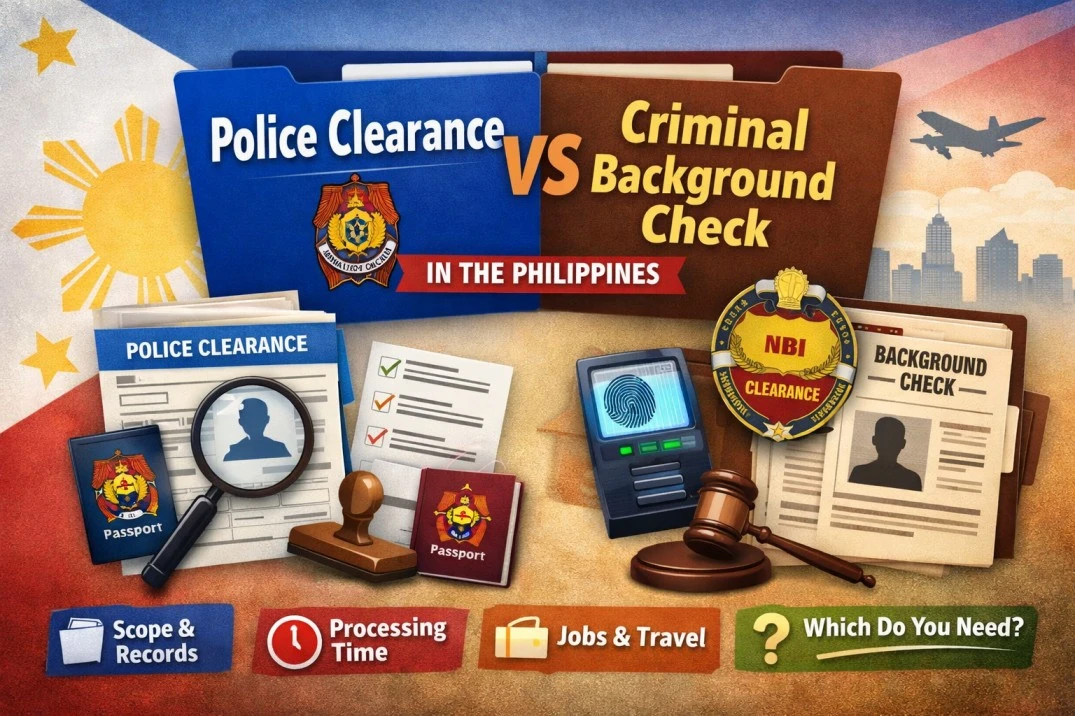
Police clearance and criminal background checks are not the same in the Philippines. They serve different purposes, are issued by different authorities, and are accepted in different situations.
A police clearance confirms that you have no record in local police databases, while a criminal background check looks deeper into national records and past cases. Job seekers, students, OFWs, and visa applicants are often asked to submit one of these documents, but many people are unsure which one they actually need. Submitting the wrong document can delay an application or cause rejection.
This guide explains the key difference between police clearances and criminal background checks, when each is required, who issues them, and how to decide which document best fits your purpose.
What Is Police Clearance in the Philippines
A police clearance is an official document that shows you have no derogatory record with the local policeat the time of application. It is commonly requested for jobs, travel, and local legal purposes.
In the Philippines, a PNP police clearance is issued by the Philippine National Police. The check is based on records in police databases, which are usually limited to local or regional coverage.
A police clearance confirms that your name does not appear in police blotters, active case files, or wanted lists handled by the police. It does not guarantee that you have no criminal history nationwide, and it does not replace deeper background checks required for sensitive roles.
A common misunderstanding is that a police clearance and a criminal background check are the same. They are not. Police clearance only verifies police records available to the PNP, not a full national criminal history.
Why Police Clearance Is Required
Police clearance is required to confirm good standing with local law enforcement and to reduce basic security risks. Many offices use it as a standard screening document.
It is commonly requested for the following purposes:
- Employment in local companies, especially for first-time job applications
- Government applications, including public sector hiring and contracts
- Business permits and licenses issued by local government units
- Visa and travel requirements for certain countries and short-term stays
- Other legal or administrative purposes, such as adoption or volunteer work
A police clearance helps organizations verify that there are no active police concerns linked to your name.
Acceptance depends on the requesting office, so always confirm which document is required before applying.
How to Get a Police Clearance
You can apply for police clearance either through a local police station or through the official online system. The process is simple if you prepare early.
Step 1: Choose your police station or NPCS portal
You may visit your nearest police station or apply online using the National Police Clearance System. Some locations require online registration before walk-in visits.
Step 2: Prepare valid IDs and basic requirements
Bring at least one valid government-issued ID. Some stations may ask for additional documents, depending on local rules.
Step 3: Submit biometric information
Your fingerprints and photograph will be captured to verify your identity and check police databases.
Step 4: Pay the police clearance fee
Pay the required fee at the station or through the payment options provided by the online system. Fees may vary by location.
Step 5: Wait for the release or download
Once processed, you may receive your police clearance on the same day or within a few days. Online applicants can usually download the clearance after it is approved.
Important notes
- Requirements may vary by location, so confirm with your selected police station.
- Some stations require an online appointment before processing applications.
Police Clearance Fees and Validity
The police clearance fee in the Philippines is usually around PHP 150, but the exact amount may vary by police station and payment method. Always check the official portal or your selected station for the current fee.
A police clearance is generally valid for six months from the date of issuance. Some offices accept it for up to one year, but many employers prefer a more recent copy. Employers often request a recent police clearance to ensure there are no new police records since the document was issued. This helps them confirm that the information is still current at the time of hiring.
What Is a Criminal Background Check
A criminal background check is a process used to review a person’s criminal history across broader databases in the Philippines. It goes beyond local police records and looks at information collected at the national level.
Unlike a police clearance, a criminal background check can include arrests and convictions, pending cases, and records filed with national law enforcement agencies. It is commonly used for background screening in sensitive or high-responsibility roles.
In the Philippine context, the most widely accepted form of a criminal background check is the clearance issued by the National Bureau of Investigation. This type of check provides a more comprehensive review compared to a police clearance.
Because of its broader scope, a criminal background check is often required when a deeper review of legal history is necessary, especially for roles involving trust, safety, or legal compliance.
How to Get a Criminal Background Check
You can obtain a criminal background check in the Philippines through authorized government agencies. The process depends on the type of check required by the requesting office.
Step 1: Choose the agency
For most purposes, you will need an NBI clearance issued by the National Bureau of Investigation. Some private employers may accept background checks from other authorized providers, but this is less common.
Step 2: Complete the application
Fill out the application form through the official system or at the selected office. Make sure all personal details are accurate to avoid issues during verification.
Step 3: Submit biometrics
Your fingerprints and photograph will be collected to check for matches in national databases.
Step 4: Pay applicable fees
Pay the required fee using the agency’s payment options. Fees may differ depending on the type of application and processing method.
Step 5: Wait for processing
After submission, your application will be reviewed. Processing time varies, and applications with name matches or existing records may take longer to clear.
Key Differences Between Police Clearance and Criminal Background Check
Understanding the differences helps you choose the correct document and avoid delays during applications.
Scope of Information
- A police clearance check is based only on local police records.
- A criminal background check reviews national records, including pending cases and past filings.
Issuing Authority
- Police clearance is issued by the Philippine National Police.
- A criminal background check is usually issued by the National Bureau of Investigation or other authorized agencies.
Processing Time
- Police clearance is generally faster because the scope of the search is limited.
- Criminal background checks take longer because of more thorough data verification.
Typical Uses
- Police clearance is commonly used for general employment, local requirements, and basic screening.
- Criminal background checks are required for sensitive roles, overseas work, legal matters, and regulated professions.
Choosing the right document depends on how detailed the background verification needs to be.
Police Clearance vs Criminal Background Check Comparison Table
This table shows the practical differences between police clearance and criminal background checks. Police clearance is suitable for basic verification, while a criminal background check is required when a deeper review of records is needed.
| Aspect | Police Clearance | Criminal Background Check |
|---|---|---|
| Issuing Authority | Philippine National Police | National Bureau of Investigation or authorized agencies |
| Coverage | Local police records | National records and filed cases |
| Processing Time | Usually faster | May take longer due to wider checks |
| Validity | Commonly six months | Usually one year (for NBI clearance) |
| Common Uses | Local employment, permits, travel | Sensitive jobs, overseas work, legal matters |
| Fees | Generally lower | Varies by agency and service type |
Which One Do You Need
The right document depends on the purpose of your application. Checking this early helps avoid delays and reapplication.
For Job Applications
- For general office jobs and local employment, a police clearance is usually enough. Employers often use it as basic proof of good standing.
- For security-sensitive roles in healthcare, education, and childcare, a criminal background check is commonly required. These positions involve trust and public safety, so deeper screening is needed.
For Travel and Visa Applications
- Police clearance may be enough for short-term travel or basic visa requirements, depending on the country and embassy rules.
- A criminal background check is required when the embassy asks for full disclosure of legal history, especially for long-term stays, work visas, or residency applications.
For Legal or Sensitive Purposes
- Courts, adoption agencies, and licensing bodies often require criminal background checks because they cover national records and pending cases.
- Regulated professions usually specify which documents are acceptable, so always follow the instructions from the requesting office.
Conclusion
Police clearance and criminal background checks serve different purposes in the Philippines. A police clearance confirms the absence of issues in local police records, while a criminal background check reviews broader national records.
Before applying, always verify which document is required by the employer, embassy, or requesting office. Requirements can vary based on the application’s purpose and the level of background review required. Acceptance depends on how the document will be used, so submitting the correct clearance matters. Applying early and preparing the right documents helps prevent delays and keeps your application process smooth.
FAQs
Is police clearance the same as a criminal background check?
No. Police clearance checks local police records, while a criminal background check reviews broader national records and pending cases.
Can police clearance replace NBI clearance?
In most cases, no. Many employers and embassies require NBI clearance for more thorough background verification.
What is required for jobs abroad?
Jobs abroad usually require a criminal background check, most commonly an NBI clearance, depending on the employer or embassy rules.
How long are these documents valid?
Police clearance is usually valid for six months. NBI clearance is commonly valid for one year, unless stated otherwise.
Can I apply for police clearance online?
Yes. You can apply through the official National Police Clearance System and book an online appointment.
What if my record shows a hit?
A hit does not always mean a criminal case. It usually requires additional verification, which may extend processing time.