
Starting or renewing a business in the Philippines requires more than registration papers. One of the most important documents you need before operating legally is the Barangay Business Clearance.
This clearance, sometimes called a business clearance, is issued by your local barangay and serves as proof that your business follows community regulations. Whether you run a sari-sari store, small café, or home-based service, you must first secure this document before applying for a Mayor’s Permit or other licenses.
In this guide, you’ll learn everything you need to know about Business Clearance, its requirements, fees, process, and sample format so you can complete your registration smoothly and avoid delays.
What Is a Barangay Business Clearance?
It is an official document issued by your local barangay. It confirms that your business is registered in the community and complies with local operating rules.
This clearance acts as proof that your business is known and approved by barangay officials. It also assures nearby residents that your work or services will not harm the environment or disrupt peace in the area.
You need this clearance before applying for your barangay clearance business permit from the city or municipal hall. It serves as the first step in securing other licenses, such as the Mayor’s Permit and BIR registration.
Why Barangay Business Clearance Matters for Every Business Owner
A Barangay Business Clearance is one of the most important documents for anyone starting a business in the Philippines. It is the first step before applying for a Mayor’s Permit or registering your business with the BIR.
This clearance confirms that your business is allowed to operate within the community. It is also known as a business clearance or brgy business clearance, depending on local usage. Each barangay issues it as proof that your operations follow community guidelines.
By 2026, many local government units (LGUs) have started integrating this process with online portals. These digital systems make it easier for business owners to apply, pay fees, and track their clearance status without visiting multiple offices.
Difference Between Barangay Business Clearance and Mayor’s Permit
Many new business owners confuse the barangay clearance for business with the Mayor’s Permit. While both are required, they serve different purposes and are issued by separate offices.
The Barangay Business Clearance is a local approval from your barangay. It confirms that your business follows community regulations and has no objections from residents. The Mayor’s Permit, on the other hand, is a license from the city or municipality that legally allows you to operate.
Below is a simple comparison table between the two:
| Category | Barangay Business Clearance | Mayor’s Permit |
|---|---|---|
| Issuing Office | Barangay Hall | City or Municipal Hall |
| Purpose | Local approval within the barangay | Official license to operate a business |
| Requirements | Application form, valid ID, proof of address | Barangay Clearance, DTI/SEC documents, community tax certificate |
| Validity | One year, renewable every January | One year, renewable after barangay clearance |
| Fees | ₱200–₱500 depending on barangay | ₱500–₱3,000 depending on business type |
Both documents are connected. You cannot apply for your barangay clearance business permit without first getting a Brgy Business Clearance.
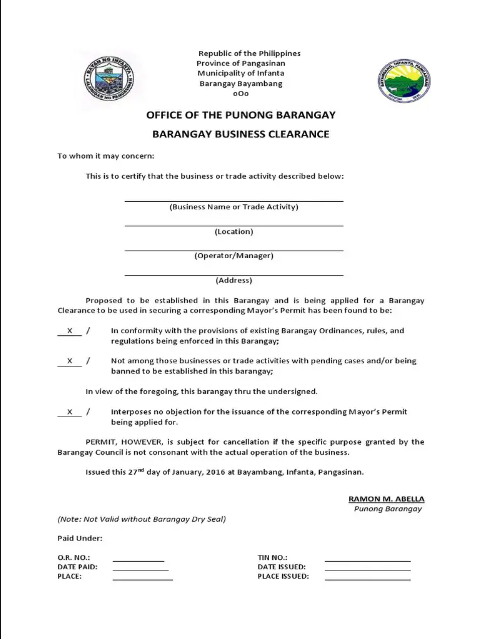
Barangay Business Clearance Format
Every barangay follows a similar pattern when creating this document. While the design may vary slightly, the layout usually contains the same key details.
Header Section
Includes the barangay logo, city or municipality name, and “Barangay Business Clearance” title printed at the top.
Main Body
Lists the business name, owner’s name, business address, and the nature of operations. This section also shows your registration or reference number.
Footer Section
Shows the issuance date, validity period, and signature of the Barangay Captain. A dry seal or digital stamp confirms authenticity.
Barangay Business Clearance Sample
Below is a sample of a Business Clearance. This example helps you understand what your final certificate will look like once released by your barangay.
Barangay Business Clearance Requirements
Each barangay follows similar rules, but details can change slightly. Check your local office for any added items before you apply.
Prepare the documents below to avoid delays at the counter. Keep originals and photocopies ready in a clear folder.
| Requirement | Description | Notes |
|---|---|---|
| Valid Government ID | Any primary ID of the owner or representative | Bring original and one photocopy |
| DTI or SEC Registration | DTI Certificate for sole proprietors or SEC documents for entities | Include Articles and latest GIS if incorporated |
| Proof of Business Address | Lease contract, TCT, or owner’s authorization to use premises | For home-based, secure lessor or HOA consent |
| Community Tax Certificate (Cedula) | Latest CTC of the owner or authorized signatory | Get from the city or municipal hall |
| Filled Application Form | Barangay-issued form with complete business details | Write the exact registered business name |
| Business Sketch or Location Map | Simple map showing your storefront or home office | Some barangays request this for inspection |
| Payment of Fees | Assessment by the barangay treasurer or BOSS cashier | Ask for an official receipt after payment |
Step-by-Step Process – How to Get Barangay Business Permit or Clearance
The process for getting your Business Clearance is simple, but each barangay may have a few small differences. Follow these steps to ensure your application runs smoothly and quickly.
Step 1 – Visit Your Barangay Hall or Online Portal
Go to the barangay where your business is located. Ask for the Business Clearance or Permit section. If your local government is part of an online system, you can check their official website to see if they accept digital applications.
Step 2 – Fill Out the Business Clearance Application Form
Get the form from the counter or, if available, download it from the barangay website. Fill in your business name, address, type of business, and owner details. Write clearly to avoid errors during verification.
Step 3 – Submit Required Documents and ID
Submit the form along with your valid ID and other required documents, such as DTI or SEC registration, a lease contract, and a cedula. The barangay officer will review them to ensure everything matches your business records.
Step 4 – Pay the Processing Fee
Once your documents are approved, the officer will issue an assessment slip. Go to the cashier or treasurer’s office to pay the fee. Always ask for an official receipt as proof of payment.
Step 5 – Wait for Inspection (if required)
Some barangays will visit your business location to check compliance with zoning, safety, or sanitation rules. Make sure your area is clean and properly labeled with your business name.
Step 6 – Claim Your Barangay Business Clearance
Return to the barangay office on the release date to claim your clearance. Verify that your name, address, and business details are correct before leaving the office.
Tip: Many LGUs now use the Business One-Stop Shop (BOSS) system. This allows you to process your barangay, Mayor’s Permit, and other licenses in one place or through a single online portal. Always ask your barangay if this option is available to save time.
How Much Is Barangay Clearance for Business?
- Most barangays charge ₱200 to ₱500.
- Larger or high-risk businesses may pay more depending on local rates.
- Fees are paid at the barangay treasurer’s office after your documents are reviewed.
- Always ask for an official receipt for proof of payment.
Validity Period
- A Brgy Business Clearance is valid for one year.
- Renewal period: January 1 to 20 every year.
- Keep your clearance updated before applying for or renewing your Mayor’s Permit.
Penalties for Late Renewal
- Late renewals can lead to surcharges or added interest fees.
- Some barangays may delay or hold your Mayor’s Permit until renewal is complete.
- To avoid penalties, set a reminder in December and renew early.
Barangay Permit for Small Business Owners
Even small or home-based businesses are required to secure a barangay permit for small businesses. This includes online sellers, freelancers, and micro-entrepreneurs operating from their homes. The clearance ensures that your business is officially recognized by the local community and follows local rules.
About the BMBE Program
Small business owners may qualify for the Barangay Micro Business Enterprise (BMBE) program under Republic Act 9178. This program supports microenterprises with benefits like:
- Income tax exemption on operations.
- Access to government financing and microloans.
- Simplified business registration with the local government.
Even if you qualify for BMBE incentives, you still need to get your barangay clearance before registration. It’s your first legal step toward becoming a fully recognized business.
Renewal of Barangay Business Clearance
It must be renewed every year between January 1 and January 20. This keeps your business in good standing and ensures a smooth renewal of your Mayor’s Permit.
What to Bring
Prepare the following requirements before visiting your barangay hall:
- Previous Barangay Business Clearance (original and photocopy)
- Updated Community Tax Certificate (Cedula)
- DTI Certificate or SEC registration (only if updated)
- Proof of payment from the last clearance
- Valid government-issued ID
Renewal Steps
- Visit your barangay hall early in January to avoid long queues.
- Submit your old clearance and updated documents for verification.
- Pay the renewal fee assessed by the barangay treasurer.
- Wait for confirmation or inspection if required.
- Claim your renewed clearance once approved.
Some LGUs now include Barangay Clearance renewal inside the Business One-Stop Shop (BOSS) system. Check if your barangay offers this online or integrated option to renew faster.
Read more about renewing a police clearance online.
Conclusion
Getting a Barangay Business Clearance is the first step toward legalizing your business in the Philippines. It proves that your operations are approved by your local community and that you meet all barangay requirements.
If you’re also processing your National Police Clearance, read our complete guides here. These guides will help you understand each document’s process and save time in your future applications.
FAQs
1. Can I apply online for Barangay Business Clearance?
Some LGUs now offer online services through their websites or the Business One-Stop Shop (BOSS). However, many still require walk-in applications to verify your documents and payment.
2. Do freelancers need Barangay Clearance for business?
Yes. If you earn from regular freelance work or services, you should secure a barangay clearance for business using your home address as your business location.
3. How much is Barangay Clearance for small business?
The cost of a barangay permit for small business usually ranges from ₱200 to ₱500, depending on your barangay and business type.
4. What’s the difference between Barangay Clearance and Business Permit?
The Barangay Clearance is issued by your barangay as local approval, while the Business or Mayor’s Permit is issued by the city or municipality as your legal license to operate.